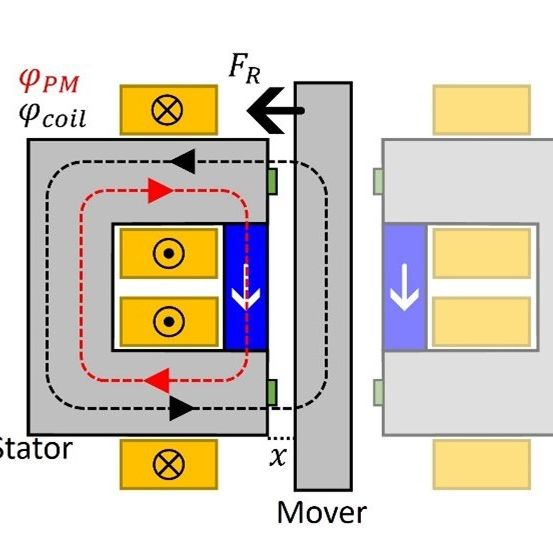
![Figure 1. Reluctance actuator with a permanent magnet placed parallel to the mover. [a] The current in the coil is negative and the flux of the coil (black) and the permanent magnet (red) are parallel in the stator. [b] The current is positive and the fluxes are anti-parallel, leading to a suppression of the magnetic saturation.](/.img/animated_true&extract_84_0_553_553&f_jpeg&s_1600x1600/dam/jcr:33cfc864-617d-4d58-8708-05de099ad73d/1b.jpg)
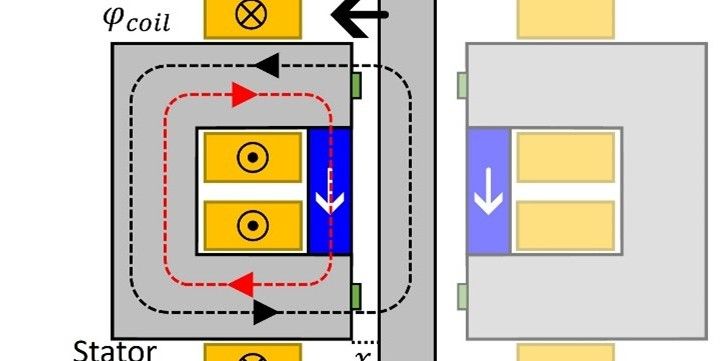
![Figure 1. Reluctance actuator with a permanent magnet placed parallel to the mover. [a] The current in the coil is negative and the flux of the coil (black) and the permanent magnet (red) are parallel in the stator. [b] The current is positive and the fluxes are anti-parallel, leading to a suppression of the magnetic saturation.](/.img/animated_true&extract_0_96_722_361&f_jpeg&s_1600x800/dam/jcr:33cfc864-617d-4d58-8708-05de099ad73d/1b.jpg)
boosting the actuator efficiency of reluctance actuators with permanent magnets.
Electromagnetic actuators are an important actuation tool to achieve positioning precision on the nanometer scale. In this realm Lorentz actuators are the mostly used, due to their linear dependence between actuation force and applied current.
Read more