
Europe's drinking water networks are aging, extensive and difficult to inspect from the inside. Leaks, contamination risks and inefficient maintenance all increase the need for reliable data from within the pipeline itself. The European TUBERS project develops scalable and modular robotic tools for pipeline inspection and repair, with the ambition to support a shift from failure-based or risk-driven maintenance toward condition-based maintenance.
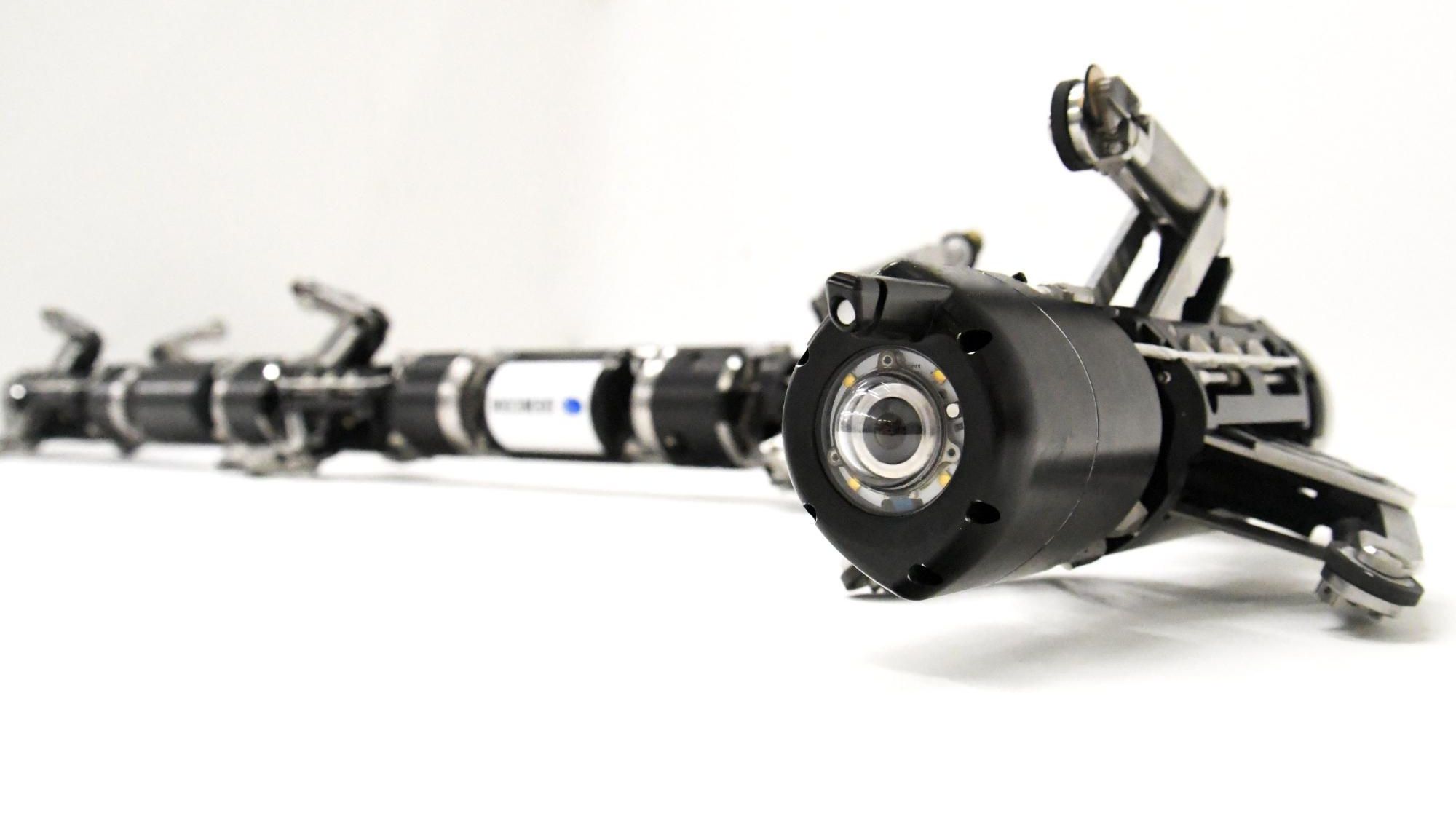
Within TUBERS, Demcon develops and improves a modular, snake-like inspection robot that can travel through water supply networks to detect leaks, congestions and other relevant pipe conditions. The robot is designed to move autonomously through pipes, collect inspection data and support drinking water companies in making better asset-management decisions.
A key part of the development is the integration of a tether system. During engineering and validation, the robot has to remain powered, controlled and connected while operating inside a closed, water-filled pipe environment. We developed an integrated tether system that enables realistic testing of the inspection robot while maintaining power supply, data transmission and sealing.
Highlights
• snake-like inspection robot for water pipes with a diameter of 9 to 30 cm
• 19 hinge-connected modules with head, drive, steering and payload modules
• 15 individually driven wheels for movement through complex pipe sections
• integrated tether system for power supply, communication and validation
• flange-mounted insertion point with sealing, tether guidance and storage
• compact tether module integrated into the modular robot architecture
• autonomous navigation trained using synthetic data before real-world deployment
developing a robot for operational pipeline environments.
An inspection robot for drinking water pipes has to operate in a demanding environment. Space is limited, the pipe is wet, bends can be tight and the robot has to deal with obstacles such as biofouling, air bubbles, narrowing and varying pipe geometries. At the same time, the system needs enough mechanical dexterity to move through the network while carrying the electronics, sensors and computing power required for inspection.
The robot architecture consists of 19 modules: two head modules, five drive modules, eight steering modules and four payload modules. The payload currently includes batteries and wireless charging functionality. This modular setup gives the robot the flexibility needed to navigate through narrow pipe sections and bends, while keeping the inspection payload distributed over the system.
The engineering challenge is not limited to movement. Mechanical connections, electrical connections and communication interfaces all have to remain reliable and watertight while the robot articulates through the pipe. This combination of mobility, sealing, sensing, power and data makes the robot a true high-tech system-development challenge.
powered, sealed and connected.
For the final application, autonomy remains the ambition. During development and validation, however, engineers need continuous access to power, communication, feedback and robot behavior. Wireless communication is limited in a closed water-filled pipe environment, and batteries alone restrict test duration and control. That is why we developed an integrated tether system.
The tether system consists of three connected subsystems: an insertion point, the tether itself and a tether module inside the robot. The insertion point is mounted to the pipe through a flange connection. It seals the water pipe, guides the tether into the pipe, stores the tether and converts the communication interface between the external test setup and the robot.
The mechanical design of this insertion point required careful control of tether alignment. A custom grooved guide wheel was developed to guide the tether and reduce unwanted friction or misalignment during deployment. The reel was reduced in size to fit the available space while still allowing controlled tether storage and movement.
Sealing was one of the critical design aspects. The system uses three axially rotating sealing rings and four static O-rings. This allows the tether to move while maintaining separation between the water-filled pipe and the external environment.
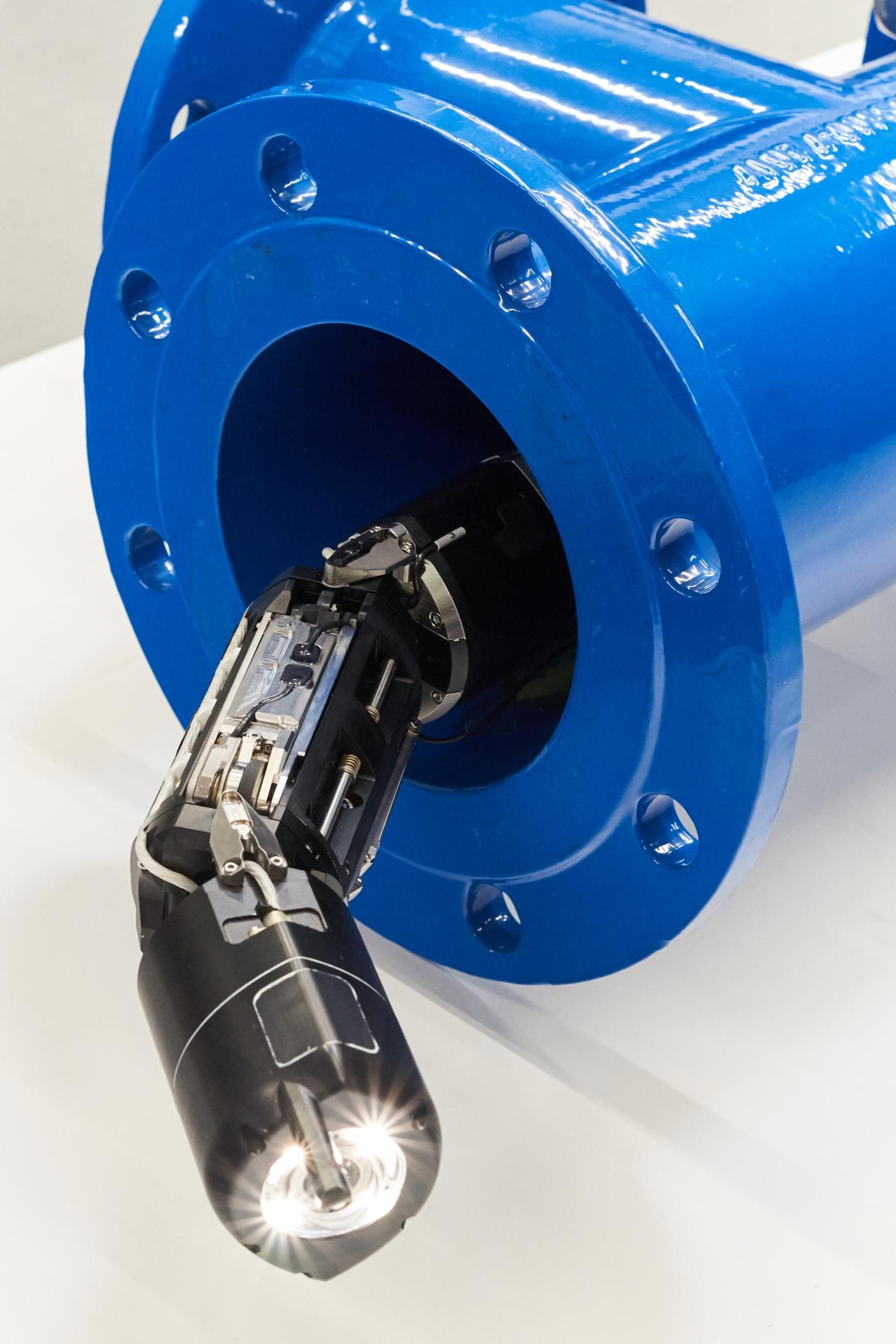
validating autonomous inspection.
The tether was treated as a critical subsystem rather than a standard cable assembly. Different configurations were evaluated, including 10- and 20-meter lengths and one- or two-pair variants. The selected configuration had to balance reliable power and data transmission, flexibility, available space and manufacturability.
Inside the robot, a compact tether module protects the cable and integrates the connection into the modular architecture. The module includes an automotive Ethernet switch for data communication and was designed for manufacturability and compatibility with the existing robot modules.
This tethered test setup enables the development team to validate robot movement, navigation software, data transmission, sealing performance and overall system behavior under realistic pipeline conditions. At the same time, the robot’s autonomous inspection capabilities are developed using synthetic data.
By training navigation and inspection algorithms before large-scale deployment, development can proceed in parallel with hardware engineering, reducing dependence on costly field testing and accelerating system validation.
Using thousands of simulated scenarios, machine learning models enable the robot to learn how to respond to situations such as blockages, leaks, defects, or splits, allowing water companies to act earlier and more precisely instead of waiting for a pipe to fail. At the same time, AI-based interpretation remains part of the validation process, particularly in situations the system has not encountered before.
The combination of robotics, mechatronics and data-driven development helps bring autonomous pipeline inspection closer to practical deployment in drinking water infrastructure.

“we have the expertise and capacity for industrialization and production.”
The next step is now to experiment with AIR in a large test network. Based on the results, the Aquatech Innovation Award-winning robot can then be developed into an industrial product. We have the expertise and capacity for the industrialization and production phases. Moreover, we see opportunities for developing similar inspection solutions for gas cooling-water and process-water inspection.