
In advanced semiconductor production machines, wafers have to be moved with sub-nanometer resolution. This requires that potential disturbances, such as heat dissipation and electromagnetic effects, are prevented. We designed a short-stroke wafer stage provided with a special metrology solution and high-efficiency motors. To this we added a complexly shaped magnetic shield, for which we developed a smart and dedicated manufacturing process.
highlights
• sub-nanometer positioning resolution
• actuation in six degrees of freedom
• magnetic shielding down to tens of nanoTesla
• complexly shaped and tightly toleranced cylinder
metrology and magnetic shielding.
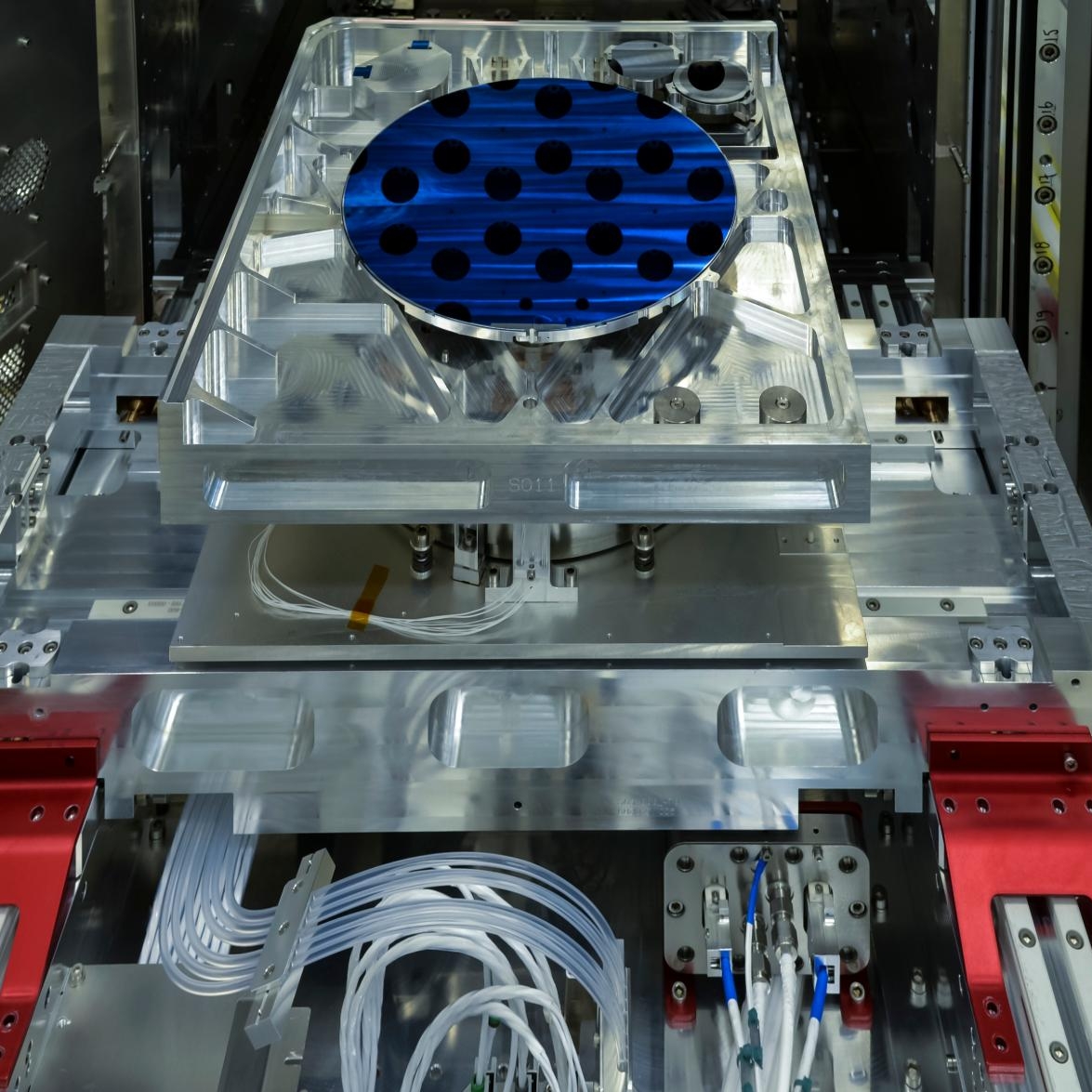
For a new machine that illuminates wafers in a high vacuum, we developed a short-stroke wafer stage. Within a wafer positioning system designed for maximum throughput and positioning accuracy, the stage’s movement has to be controlled with sub-nanometer resolution. For this, we came up with a special metrology solution: a metro-frame that enables position measurement with feedback to the wafer positioning system. We used high-efficiency linear electromotors, for which we devised an ingenious solution to achieve actuation in six degrees of freedom.
manufacture and qualification.
The stage design was subject to strict electromagnetic requirements. Therefore, we designed the stage’s motor housing as a complexly shaped, tightly toleranced cylinder to perform the function of a magnetic shield. Together with manufacturing partners we developed a sophisticated manufacturing process for sheets made of so-called mu-metal, a nickel-iron alloy. This involved laser cutting, laser welding and annealing to remove all mechanical tension for an optimal magnetic shielding. We took care of production, plus qualification, of the complete short-stroke wafer stage, including the special housing.
"we optimized our design for cost, assembly and maintenance."
We assumed responsibility from concept development to serial production. To optimize our design for cost, we weighed off the technical specifications against the cost of components such as sensors. We followed a design-for-assembly and design-for-maintenance approach. The focus was on safeguarding the cleanliness of the components and integrating the complete stage as an easily swappable unit into the customer’s system. This was particularly challenging because the system’s small footprint restricted the available volume.