

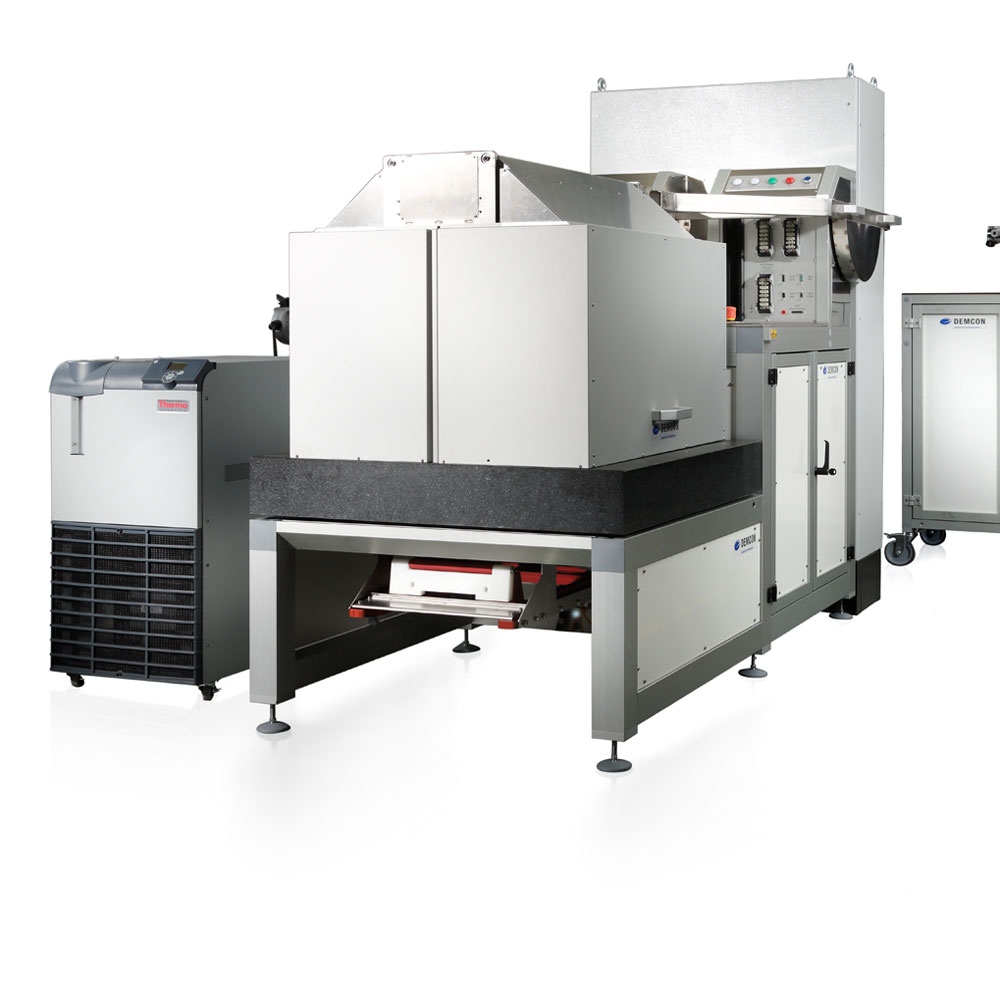
ASML uses qualification tools in the development and production of systems such as position modules. These tools have to qualify system performance in terms of functionality, precision, throughput, etc. Drawing on our extensive experience in this area, we focused the design of the PMQT4 qualification tool on helping ASML to accelerate development and streamline production.
highlights
• qualification of over 200 parameters
• mechanical interface matching the ASML machine
• seperate long-stroke/short-stroke testing
• real-time control in several degrees of freedom
more connectivity tests.
The PMQT4 is a fourth-generation Position Module Qualification Tool for a wafer positioning module of ASML’s NXT platform. The tool tests and qualifies a large number of properties and parameters. These range from connectivity (electric, pneumatic and water) to positioning precision and dynamic behavior, in the magnetic, electrical, mechanical, thermal and software (control) domains. We created a completely new design in which the number of connectivity tests was expanded, the reliability of the tool was increased further and the ergonomics (accessibility of the tool) were improved.
better usability design.
For accurate positioning over a wide range, the module contains separate stages for long-stroke and short-stroke movements. We have designed the PMQT4 to make it possible to test these long-stroke and short-stroke stages separately, to facilitate and accelerate the development process. We realized the PMQT4, just like other qualification tools, on a turnkey basis. Because the tool is deployed in production at ASML, it must be fast and simple to operate and have as little downtime as possible. To that end, we addressed usability in the design phase and provide for maintenance and service.
“we created an optimal fit between ASML’s module and our tool.”
We developed the PMQT4 as a kind of artificial machine around the position module to be tested. Based on our understanding of ASML’s hardware and operating systems, we designed interfaces to create an optimal fit between their module and our tool. In collaboration with their engineers, we conducted a failure mode and effects analysis, to determine the required tests and parameter qualifications. All in all, our qualification tool track record for the NXT platform helped us to qualify for ASML’s next platform generations, NXE and EXE.