The quantum industry is developing rapidly. New startups are emerging, and scale-ups are growing, particularly around Delft, the Netherlands. Internationally, there’s also growing interest in quantum computing, quantum sensing, and quantum communication. Given the complexity of the technology, the transition from prototype to product is a significant one. Demcon encounters this challenge with increasing frequency. The company has been working on high-tech systems for semiconductors, big science, and aerospace for decades, and uses this solid foundation to help quantum teams take the next step toward industrialization.
introduction
The Netherlands boasts a compact and robust quantum community where universities, research institutes, startups, and technology partners quickly connect. The Delft region plays a pivotal role in this development. Demcon considers it part of its strategy to strengthen this sector with its extensive knowledge and experience in product development. By helping companies scale up, Demcon contributes to greater continuity, better alignment with industrial standards, and a greater chance that quantum technology will truly make an impact beyond the lab.
The next phase in the quantum sector is less about fundamental physical performance and more about reproducibility, reliability, and cost control. This requires industrialization, clear architectures, and systems designed for production. Demcon positions itself explicitly in this role. ‘We contribute to the systems and roadmaps, because we believe we can make a difference in that crucial leap from prototype to product’, says Vincent Fokkema, managing director at Demcon high-tech systems Delft.
industrialization.
Startups and scale-ups often approach Demcon when their prototype is working and the next investment round or a launching customer is on the horizon. Then, it often becomes clear that research-based choices aren’t necessarily suitable for production environments. For example, thermal stability often proves more critical than anticipated during the prototype phase. In addition, new requirements regularly arise, such as the condition that the alignment must remain stable during transport and thermal cycling. Demcon uses the V-model to structure this process: from requirements and concept selection to detailed design, simulation, integration, verification, and validation. This approach highlights where the technical risks lie and which design decisions have the greatest impact.
The challenge for quantum companies is that they don’t have the capacity and experience to take that industrialization step themselves. Of course, they could build up that expertise internally, which would be very time-consuming at a stage where time-to-market is essential. Also, they want to stay focused on the core of their technology: improving qubits, refining single-photon mechanisms, or further developing their sensing principles. ‘Quantum companies have an excellent understanding of how their technology works and how it fits into the entire quantum system, but they often lack the bandwidth to engineer everything themselves’, says Martijn Krijnen, business developer at Demcon high-tech systems. ‘Demcon does have that capacity. We have years of experience in multidisciplinary systems engineering and requirements management. We also house a range of relevant technical competencies. Demcon is therefore a very good industrialization partner for quantum companies.’
customized capabilities.
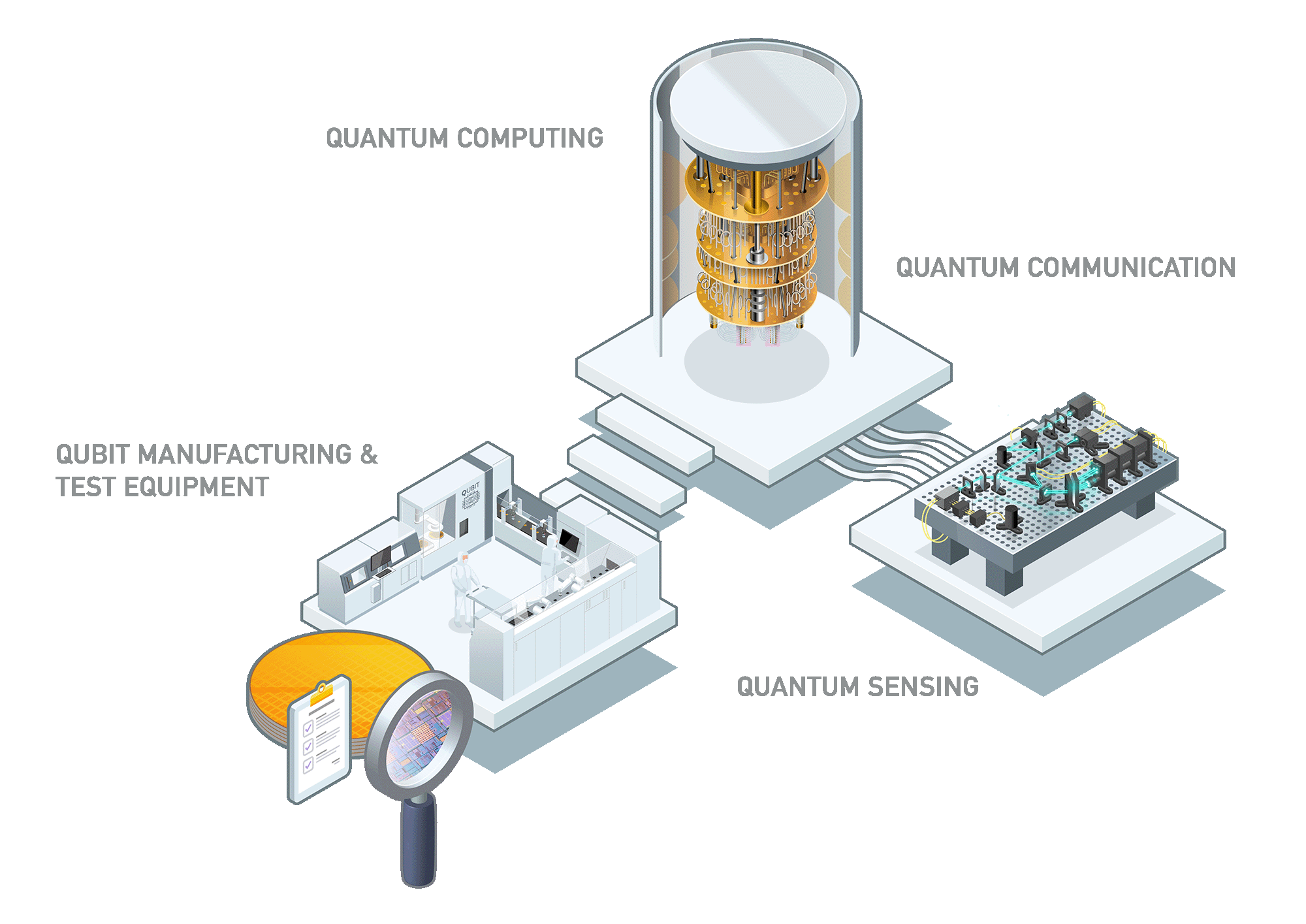
Demcon can quickly engage in quantum projects because many of the preconditions are familiar ground. For decades, the semiconductor industry has had stringent requirements for mechanical and thermal stability. In big science, topics such as vacuum, magnetic fields, and cryogenics play a key role. Aerospace projects, meanwhile, demand optomechatronic precision and flawless thermal control. ‘We recognize these conditions. This enables faster progress toward a manufacturable system’, says Fokkema. Several critical design aspects can be addressed in quantum computing, sensing, and communication:
Several critical design aspects can be addressed in quantum computing, sensing, and communication:
- Extremely high vacuum: to prevent disruptive interactions with random particles, an extremely high vacuum (XHV) is required in quantum systems, for example for trapped-ion and neutral-atom systems. Demcon models systems for parameters such as ultimate pressure and pump-down time to improve the performance and turnaround time of test cycles.
- Cryogenics: Quantum devices sometimes require extremely low and precise temperatures: down to 10 millikelvins for superconducting qubits. Even minimal thermal drift can affect qubit coherence. Demcon designs these cryogenic environments end to end, from cooling architecture and material selection to thermal interfaces. Using multiphysics simulations, the team predicts heat flows and thermal stability.
- Vibration isolation: Vibrations can contribute to decoherence and generate localized heat, which is detrimental in a cryogenic environment. Furthermore, vibrations must not exceed a fraction of the laser wavelength at which a qubit is excited. Demcon designs low-vibration architectures, for example, using flexure mechanisms.
- Magnetic shielding: Some quantum devices are very sensitive to fluctuations in the magnetic field. Demcon develops both passive and active magnetic shielding that creates a stable and homogeneous field. Simulations are used to optimize materials and geometries to minimize external influences.
- Optomechatronics: The mechatronic requirements are also high. Demcon develops optomechatronic modules in which optical elements, positioning, and mechanical stability are designed as a single system. This includes beam shaping, active and passive alignment, and optical columns that are resistant to thermal and mechanical variations.
By bringing all disciplines together within a single development organization, design trade-offs are made in parallel rather than sequentially. Krijnen: 'Our added value is that we can combine all these physical principles and competencies into an optimal, customized solution. This shortens development time and prevents suboptimization'.
flexible partner.
Quantum companies operate in an environment where specifications are constantly evolving. Demcon therefore holds weekly technical sessions with its clients to align design and physics insights. Fokkema: ‘It’s always a very close, collaborative process. Their research continues as our design evolves, and those developments must be constantly aligned.’ Multiphysics simulations allow for early validation of designs so that adjustments can be processed more quickly and testing can be scheduled more efficiently.
Sometimes adjustments are small and easy to integrate. Sometimes an entire subsystem needs to be revised, or a project is paused because of new insights. Demcon therefore builds projects in phases, so that each step independently provides value for investors, internal stakeholders, or end users. In addition to technical implementation, Demcon contributes to roadmapping, risk assessment, and supporting technical substantiation toward investors. This aligns with the role Demcon often fulfills in emerging technology areas: technical partner and experienced guide throughout the industrialization process.