In order to meet the ever-increasing demands of large telescopes, laser guide stars are being used for adaptive optics correction. These artificial reference stars are created by a Laser Projection System (LPS), which has a Beam Conditioning and Diagnostics System (BCDS) as one of its critical subsystems. Building on its works for the Very Large Telescope (VLT), TNO recently won the tender for the Extremely Large Telescope’s LPS. Demcon focal was challenged to design a BCDS that combines easy maintainability with strict optical requirements concerning laser beam quality and pointing stability, taking into account large thermal and mechanical load variations.
Introduction
Large ground-based telescopes are equipped with adaptive optics (AO) to correct for atmospheric disturbances. The AO input can be provided by either bright reference stars or – in the absence of such stars within the actual field of view – bright artificial stars, which can greatly increase the tele scope’s sky coverage. Laser guide stars are created by using a Laser Projection System (LPS) to excite the sodium atoms (at λ = 589 nm) that originate from the ablation of micro meteorites in the Earth’s mesosphere at an altitude of ~90 km.
For example, one of the four telescopes of the VLT, operated by the European Southern Observatory (ESO) at Cerro Paranal in Chile, is fitted with four LPS systems, for which Dutch applied research organisation TNO designed and realised the Optical Tube Assembly (OTA) [1]. Combined with other instruments in VLT’s AO facility, these LPS systems enable the correction of the blurring effect (wavefront degradation resulting in decreased optical resolution) of the Earth’s atmosphere in real time and aid in the creation of images that show astonishing sharpness.
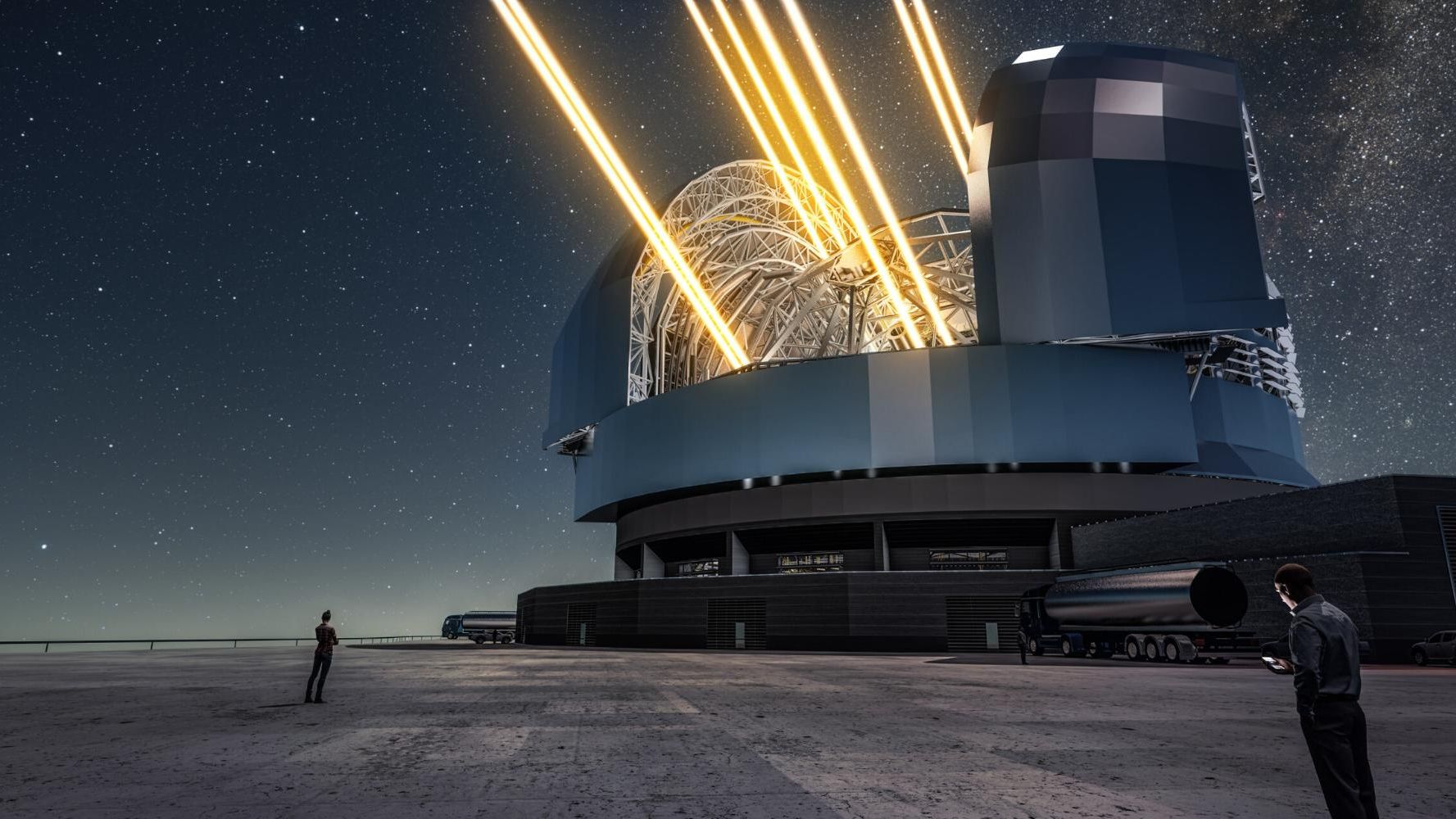
Currently, ESO is developing the next in line: the 39-meter Extremely Large Telescope (ELT). This is currently under construction at Cerro Armazones in Chile and is designed to be the largest visible- and infrared-light telescope in the world: the world’s biggest eye on the sky [2]. The ELT can be equipped with up to eight LPS systems (Figure 1) to cover the atmospheric variations in its large field of view.
Building on its experience with VLT, TNO won ESO’s tender for the ELT LPS (Figure 2) and partnered with Demcon focal as the subcontractor for the design and realisation of the Beam Conditioning and Diagnostics System (BCDS) and Control Electronics. Since early 2021, TNO and Demcon focal have been working on the development of the ELT LPS [3] [4], which includes the control electronics and software, as well as dedicated tooling for beam quality measurement, maintenance and verification (test tooling).
optomechanical layout.
Figure 3 shows the functional overview of the LPS. As well as the baseplate (fixed to the tilting part of the ELT) and the cover, the optomechanical layout comprises the laser head (for Toptica’s 589-nm, 50-W continuous-wave SodiumStar laser source), the BCDS (designed by Demcon focal) and the OTA (designed by TNO). The laser head is mounted on top of the BCDS, subjecting it to a large mechanical load due the head’s mass of 80 kg. The cover encloses the complete LPS to protect it from heavy wind loads and to ensure the high optical quality of the transmitted laser beam.
The BCDS directs the laser beam from the laser head to the OTA, where a Field Selector Mirror controls the pointing of the output beam. The function of the BCDS is to manage beam conditioning and diagnostics, ultimately to support the control of optical beam quality.
Beam conditioning is provided by the remotely controlled Beam Expander Unit (BEU), which expands the beam – with a factor of 3.6, from Ø4.2 mm to Ø15 mm – and controls its focus. Refocusing the beam is required because the optical distance travelled by the laser beam can vary due to the thermal (day-night) cycling the system undergoes and the changes in the elevation angle of the telescope platform. In addition, the Jitter Loop Mirror acts as a highly dynamic tip-tilt mirror to correct for high-frequency laser jitter.
Beam diagnostics involves measurement of beam stability by the Periscope and of optical beam power by the water cooled Bolometer, when the Beam Propagation Shutter steers the beam in that direction.
design.
The main design challenge was to provide high optical beam quality in terms of wavefront error, degree of linear polarisation and high optical throughput, as well as high pointing accuracy and stability, while the BCDS is being exposed to varying environmental conditions, including thermal (day-night) cycling and a changing gravitational vector due to tilting of the ELT. As a consequence of the optical design, any pointing-angle variations at the LPS input are demagnified by a factor of 72 (the BCDS and OTA contributing a factor of 3.6 and 20, respectively); lateral offsets, however, are magnified by the same factor. This required an LPS system-level approach for handling the thermal and mechanical (gravity) loads.
The design of the BCDS (Figure 4a) involved the custom design of various submodules combined with the selection of the appropriate off-the-shelf components, such as actuators, mirrors, lenses and their coatings, providing the right properties in terms of throughput, polarisation and optical tolerances. All submodules were designed as Line-Replaceable Units (LRUs) that are placed on the BCDS baseplate (Figure 4b) and provided with kinematic mounts for easy exchangeability during maintenance and high repeatability in mounting.
Athermalised and stiff
During operation, the LPS will experience temperature gradients of up to 0.55 °C/hr. Therefore, an athermalisation strategy was applied to the BCDS design, to match the thermal time constants of BCDS components with each other and with those of the OTA. One the design choices was to select inox steel (AISI 304 and 316L) as the material for most components, as this is also the prevalent material in critical parts of the ELT structure.
Additionally, BCDS was given a high stiffness to ensure structural stability, thus minimising deformations due to varying thermal and mechanical loads.
The frame stiffness derives from its construction with traingular elements made out of steel beams, having a cross-section of 40 mm x 40 mm. This design also enables easy access to all submodules inside. According to ESO’s design review, it was the most stable structure that could have been designed.
BEU design
To illustrate the custom design of submodules, the BEU design is presented here (Figure 5). It comprises two major components, namely the optical barrel and the adjustable BEU frame. The optical barrel consists of subcells, with each lens mounted in a separate subcell. Optical feedback is used to align the lenses to the required accuracies of ±10 μm in lateral displacement and ±50 μrad in tip/tilt rotation. After alignment, the lenses are fastened using an epoxy adhesive. Focus control in the optical barrel is realised by moving the second lens of the BEU (L2) along the optical axis of the BEU, while keeping L1 and L3 fixed in place. This is achieved by using a commercially available linear stage L-505 from PI. Its resolution and range enable a focus control of ±5, with 0.01 resolution, both in terms of wavelengths (peak-to-valley).
The BEU frame allows for adjustments of the optical barrel in four degrees of freedom (DoFs) – Tx, Ty, Rx and Ry, where the optical axis of the optical barrel forms the z-axis. The translations and rotations are achieved with fine-threaded differential screws. The minimum range of motion was determined to be ±725 μm and ±2.63 mrad, with corresponding resolutions of ±5 μm and ±25 μrad. After adjustment, the system is locked by fastening dedicated locking screws.
Control
Overall control of the LPS pointing direction is done by ESO, which provides separate setpoints for the BEU, JLM and FSM. The control electronics that translate these setpoints into appropriate actuator actions for the BEU and JLM were designed by Demcon focal, while TNO designed the one for the FSM. Due to the strict requirements, quite some effort had to be put in controller tuning. For the JLM, for example, this resulted in excellent dynamic performance of its piezo stage: 240 μs rise time; 480 μs settling time (10% margin); and 3% maximum overshoot. This was better than the nominal specifications provided by the supplier (PI).
analysis.
Critical performance parameters were studied by extensive analysis of the thermal and structural behaviour of the BCDS, a few results of which concerning laser beam quality and stability will be highlighted here. The quality of the laser beam output was determined using optical analysis. It was concluded that the degree of linear polarisation was above 95%, while transmission was nearly 95%. The BCDS wavefront error (excluding tip/tilt and defocus errors) was found to be under 40 nm RMS, below the requirement of 41 nm RMS. The stability of the laser beam at the BCDS output can be affected by multiple error sources, in particular thermal effects, changing elevation and the L2 lens motion during focus actuation of the BEU. The impact of these error sources was studied using optical ray tracing combined with finite-element method (FEM) analysis.
Thermal
Concerning the thermal effects, the athermalisation strategy had been aimed at matching the thermal time scales (and associated coefficients of thermal expansion) of the individual BCDS components to prevent significant thermal gradients and transients in the system. A lumped-mass model was used to justify the assumption of equal thermal time scales and the subsequent performance of a static thermal analysis, using a uniform temperature distribution. From this analysis, the displacements and rotations of the optical components and their interface points were determined and used to calculate the resulting deviations in the transmitted laser beam. For the temperature range of 0-15 °C, the beam position error due to temperature was found to be limited to 15 μm.
Mechanical
During operation, the ELT – and hence each BCDS system – will be tilted from 0° to 60° zenith angle (i.e. from 90° to 30° elevation angle) and consequently the direction of the gravitational vector with respect to the system will change. As a result, the frame and the internal components of the BCDS, with the 80-kg laser head on top, will deform under a varying load, affecting the position and the pointing direction of the laser beam. From a FEM analysis of the BCDS tilting performance, it was concluded that the total laser beam pointing error remained below 1 μrad and was almost unaffected by the tilt of the system. Taking the 0°-tilt configuration as reference, the deviation of the laser beam position was also found to be barely affected and the calculated beam position change due to system tilt was less than 15 μm.
BEU error
The BEU error contribution derives from the linear stage that actuates L2, in particular its motion stability and the alignment accuracy of its motion axis with respect to the optical BEU axis. Based on specifications concerning the straightness, flatness and rotational errors of the BEU stage, and an alignment accuracy of better than ±1 mrad, a pointing error of less than 5 arcsec was calculated.
summary.
The summary of performance specifications at the BCDS output (Table 1) gives an indication of the optical beam quality and the stability of the laser beam pointing and position under varying environmental conditions.
first light.
This summer, Demcon focal passed the final review for its BCDS design and the first system is already under construction. Next spring, the system will be integrated with TNO’s OTA for LPS system verification to reach provisional acceptance by ESO at the end of 2023. The testing procedure covers the extreme mechanical and thermal conditions the LPS will be subjected to. For example, a dedicated tip-tilt trolley was designed for the mechanical testing, while final testing will take place in a climate chamber to simulate the temperature regime on the Cerro Armazones mountain-top.
The first new LPS will be installed on one of the VLT telescopes (three of them do not have any LPS at the moment). After that, LPS systems for the ELT will be built, for which Demcon focal is planning to commission a new assembly facility in Delft. By 2027, the new TNO/Demcon LPS systems will have been installed on the ELT to provide reference to the world’s biggest eye on the sky, which is then expected to achieve technical ‘first light’.