From 20 to 22 January 2026, Demcon high-tech systems will attend the SPIE Photonics West exhibition in San Francisco, the leading event for photonics technologies and applications in areas such as lasers, optical systems, imaging, sensing, and precision solutions. Find us at booth #5305 in the Holland Pavilion to learn more about our integrated approach merging optics, mechanics, and control technologies to deliver robust, high-precision systems for photonics applications.
About
Photonics is a key enabler for progress in semiconductor manufacturing, quantum technology, and advanced optical systems. These fields require extreme precision and multidisciplinary integration. The SPIE Photonics West Exhibition brings together industry and research to showcase innovations that advance imaging, sensing, and optical engineering. It provides a platform for collaboration and technological development in photonics.
Our focus at SPIE Photonics West
Heterogeneous integration technologies
Optical wireless communication
Production equipment & metrology
Connect with us at SPIE Photonics West exhibition
Visit Booth #5305 in the Holland Pavilion at SPIE Photonics West to meet our experts and explore how we engineer solutions for photonics challenges.
Visit the SPIE Photonics West website to learn more here.
Recent highlight: Laser Guide Star systems for ESO
Our expertise in photonics is demonstrated through the Laser Projection Systems developed by Demcon focal in collaboration with TNO for the European Southern Observatory (ESO). These systems, now operational at the Very Large Telescope (VLT) in Chile, use advanced laser technology and adaptive optics to enable high-resolution astronomical imaging. This capability is essential for observing exoplanets and studying phenomena near the Milky Way’s supermassive black hole.
Read the full press release on the Laser Guide Star sytems here:
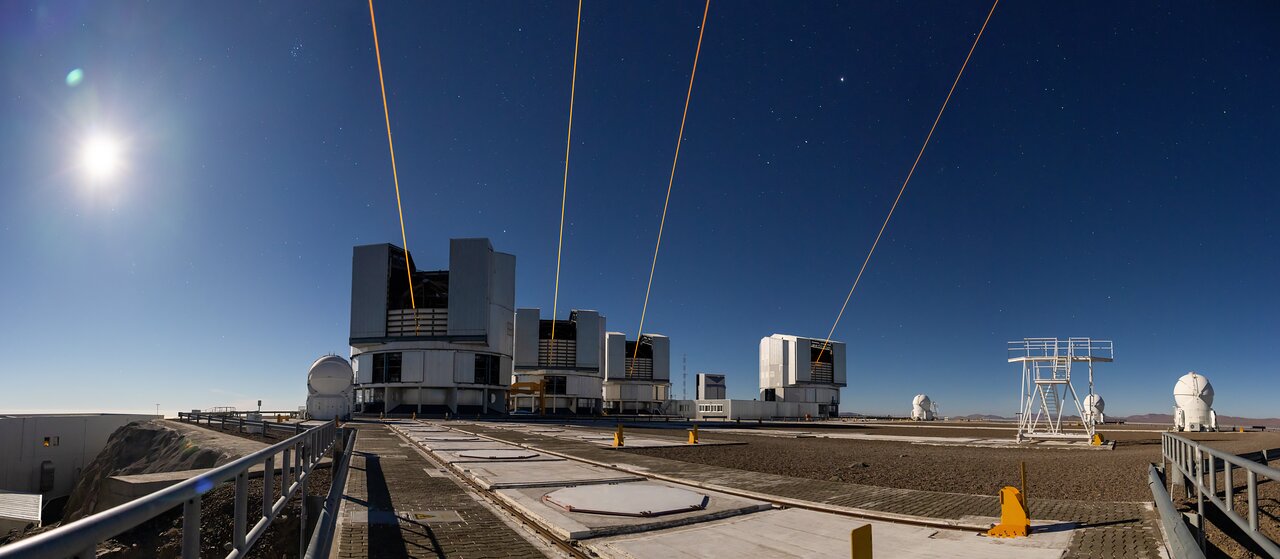

Laser trial run kickstarts new era of interferometry
Last week, four lasers were projected into the skies above the European Southern Observatory’s (ESO’s) Paranal site in Chile. The lasers are each used to create an artificial star, which astronomers use to measure and then correct the blur caused by Earth's atmosphere. The striking launch of these lasers, one from each of the eight-metre telescopes at Paranal, is a significant milestone of the GRAVITY+ project — a large and complex upgrade to ESO’s Very Large Telescope Interferometer (VLTI). GRAVITY+ unlocks a greater observing power and a much wider sky coverage for the VLTI than previously possible.